
Virtual assistant via mobile phone, tablet or robot to improve the quality of life of the elderly and the provision of social and health services
Virtual assistant to monitor patients at home
The aim is to establish a communication channel with patients through a robotic virtual assistant capable of interacting with users by voice. Using language technologies, GiDi will classify patients according to the severity of their condition and implement personalised protocols for action.

The project started in June 2022 and will end in October 2024.
Budget: €1,109,785
Partners: Balidea (leader) + IDMind
Collaborators: Multimedia Technologies Group of the University of Vigo and the IDIS Foundation
Support received
This project has been subsidised by the Centre for Technological Development and Innovation (CDTI).
It has also received funding from the Eurostars-3 joint programme with co-funding from CDTI and the European Union's Horizon Europe Framework Programme for Research and Innovation.

Balidea
We make sure GiDi communicates naturally
Balidea focuses on the conversational level. GiDi allows chronic patients to be monitored at home. Through conversation with patients, it executes screening protocols designed by specialist doctors, collecting data in real time that reaches medical services for the implementation of personalised protocols.
Balidea has also developed, in collaboration with medical specialists, a system for predicting the evolution of patients using Artificial Intelligence. We help medical services to pay more attention to those patients whose evolution is expected to be less favourable.
IDMind
We make sure GiDi moves in a user-friendly way
The role of IDMind is mainly related to the design of the robot. They are evolving a social robot that, in addition to monitoring users from a medical point of view, will move autonomously around their homes, being able to locate, identify and communicate with them with the most human and friendly behaviour possible.
As collaborators of Balidea, the Multimedia Technologies Group (GTM) of the University of Vigo supports us in the development of the conversational interfaces, and the IDIS Foundation is responsible for defining the medical screening and protocols to be implemented.
Challenges
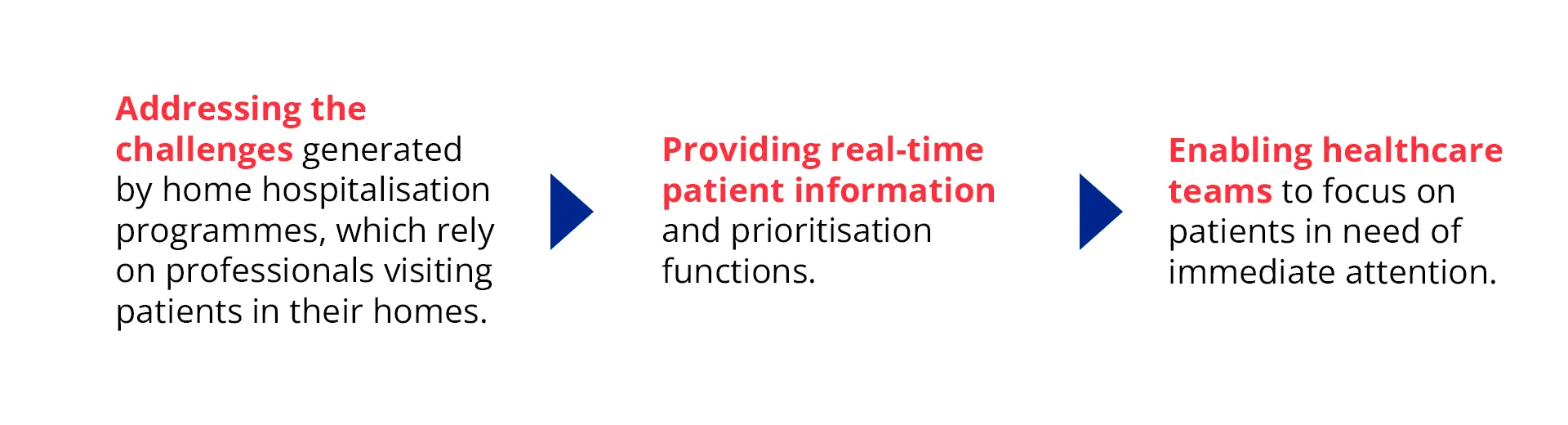
Abordar los desafíos generados por los programas de hospitalización a domicilio, que dependen de la visita de los profesionales a los pacientes en sus casas.
Proporcionando información en tiempo real sobre los pacientes, así como funciones de priorización.
Permitiendo a los equipos sanitarios centrarse en los pacientes que necesitan atención inmediata.
Impact
From an Ethics by Design approach, the users themselves have participated in both the design and validation of the solution. GiDi is a success story in the application of open source language technologies in a medical environment, supporting professionals in routine tasks and providing real-time patient information. It is a solution with a great potential to transform home healthcare.
Functionalities
Screening protocol simulation
Allows users to initiate and simulate the screening protocol and report measurements.
Dashboard
Medical specialists have real-time patient information and receive alarms.
Use of multiple languages
Bilingual Galician/Spanish conversations. Recognises the user's language and changes accordingly.
Natural Language Processing
It is able to understand patients by identifying key words and remembering previous conversations.